
When Is the Best Time to Prune Trees in Hawaii?
Hawaii's tropical climate changes pruning timing. When to thin canopies for storm season, when to prune for flowers and fruit, and when to wait.
· 5 min read
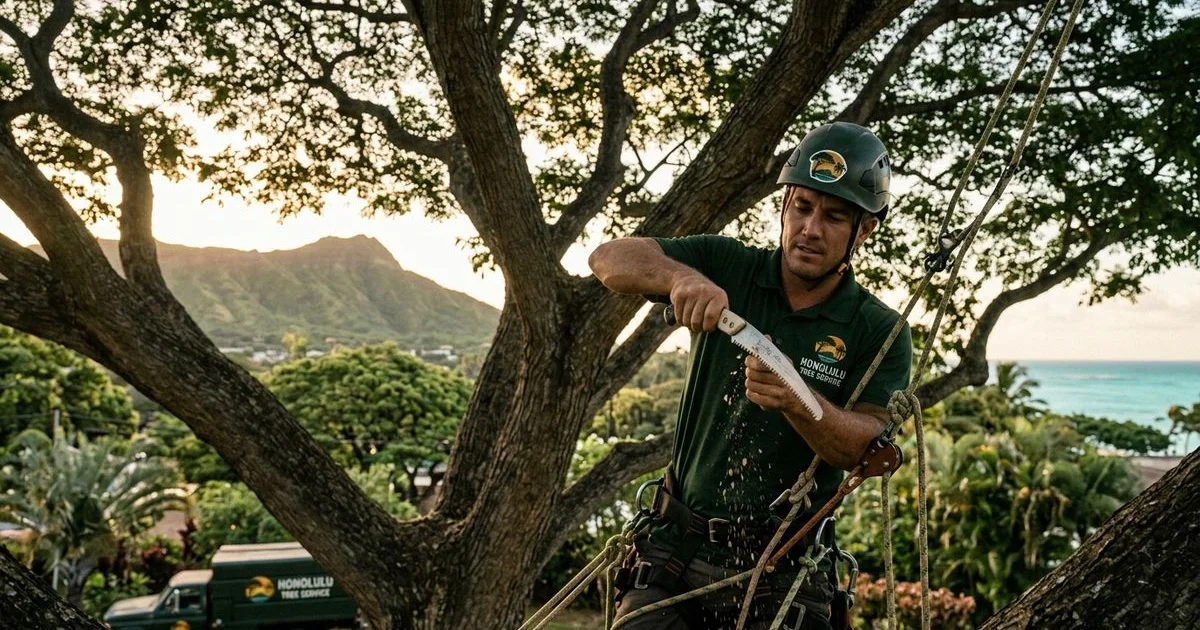
We often see homeowners trying to find the best time to prune trees Hawaii, only to rely on mainland gardening advice that simply does not work here.
The truth is that our year-round growing season completely changes the rules for tree care.
Mainland schedules rely on a winter dormant period, but our island environment demands a completely different approach.
We use these specific windows to optimize storm preparation, floral displays, and fruit production.
This guide breaks down the exact timeline for tree trimming and pruning on Oahu.
Our team will show you exactly how to schedule your property maintenance for the safest and most beautiful results.
Why Hawaii Pruning Timing Is Different
Our team always reminds clients that the best time to prune trees Hawaii offers depends entirely on your specific property goals. You do not have a standard dormant winter season to rely on for easy scheduling.
Most local canopy species can be maintained at any point in the year, but specific objectives require strict timing.
| Factor | Mainland Tree Care | Hawaii Tree Care |
|---|---|---|
| Growth Cycle | Distinct winter dormancy | Year-round continuous growth |
| Primary Goal | Spring leaf-out prep | Hurricane wind load reduction |
| Timing | Strict late winter window | Species-dependent flexible windows |
Pre-Storm Pruning (May-July)
The most critical pruning season Hawaii experiences is the immediate run-up to hurricane season. Hurricane season officially runs from June 1 to November 30.
The 2026 Central Pacific forecast predicts 5 to 13 tropical cyclones, making early preparation essential for property safety. We prioritize late-spring and early-summer thinning to give trees time to heal before peak wind months arrive.
Your goal is to reduce wind load through strategic crown thinning. This strategy opens up the canopy so wind can pass through safely instead of pushing against a solid wall of leaves.
This is especially important for:
- Mature monkeypods, banyans, and other large canopy trees.
- Coastal palms exposed to consistent trade winds.
- Any tree within 10 feet of a Hawaiian Electric (HECO) power line.
- Trees near a structure where failure would cause major damage.
We strongly advise booking your service in April or May before pre-season demand spikes.
Flowering and Ornamental Species
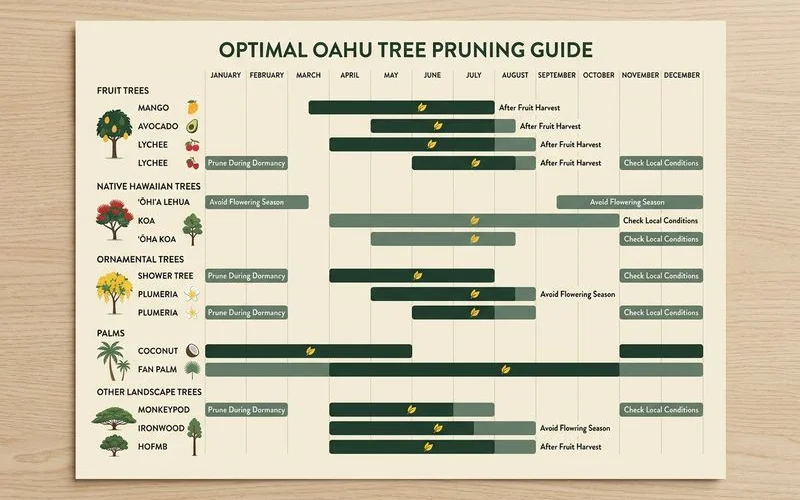
You need to time your cuts around the bloom cycle for flowering and ornamental species to avoid cutting off next year’s buds. Pruning during active flowering removes blooms and sometimes damages the next cycle.
Our arborists follow a specific schedule to maximize these vibrant floral displays.
- Plumeria: Prune in late winter (January or February) before new growth accelerates.
- Shower trees: Schedule structural maintenance in early spring before peak bloom.
- General ornamentals: Make your cuts just after the main flowering cycle ends.
Flowering trees are forgiving, but proper timing ensures a much better bloom next year.
Fruiting Species (Mango, Avocado, Citrus)
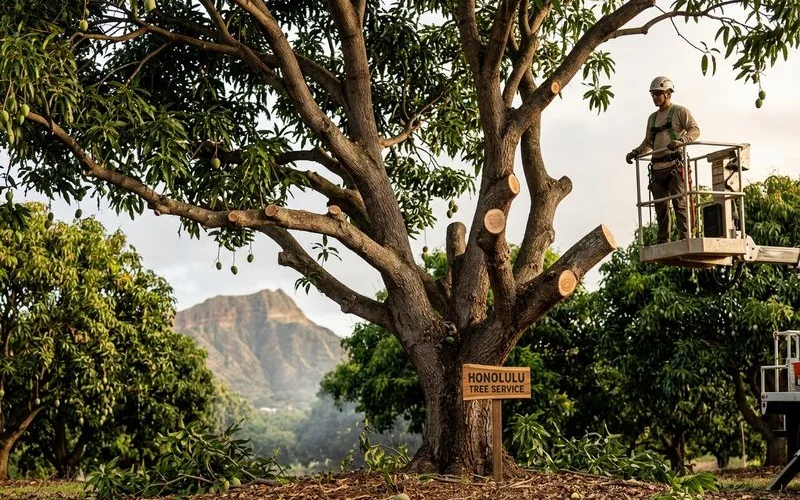
If you are wondering when to prune Oahu fruit trees, the rule is generally immediately after the harvest. The University of Hawaii College of Tropical Agriculture and Human Resources (CTAHR) advises that timing is critical to ensure the next growth flush produces flowers instead of just leaves.
Our specialists see many homeowners make the mistake of heavy cutting during early fruit set, which causes the tree to drop its crop entirely.
- Mango: Make your cuts after the July through September harvest and before late fall flowers begin.
- Avocado: Stick to light maintenance year-round, saving heavy structural work for post-harvest.
- Citrus: Schedule this work in late winter before the bloom or lightly after harvesting.
Palms
Palm maintenance runs on a strict calendar schedule rather than a seasonal clock. Most palms require twice-yearly servicing to remove dead fronds and coconuts safely.
We set up routine maintenance visits because these trees have no strong seasonal preference for trimming.
- Residential properties: Schedule in spring and fall.
- Coastal high-exposure areas: Service every four months.
- Commercial properties: Maintain on a quarterly basis.
Year-Round Operations
Certain emergency and maintenance tasks are perfectly fine to execute at any time of year. Dead branches and broken limbs do not care about the calendar.
Our crews handle hazard mitigation immediately to protect property and people.
- Deadwood removal: Extracting dead branches prevents property damage.
- Hazard mitigation: Taking down broken or leaning limbs is always an immediate priority.
- Storm response: Emergency clearing happens exactly when the damage occurs.
- Crown raising: Lifting the canopy for clearance causes minimal stress to the tree.
Legal Considerations on Oahu
You must verify a tree’s legal status before starting any year-round operation. Honolulu’s Exceptional Tree Program currently protects over 1,400 designated trees across the islands due to their historic or cultural value.
We always check this registry because altering these trees requires a special permit from the Department of Parks and Recreation. Attempting to trim an Exceptional tree without an approved application and an ISA-certified arborist on site can lead to severe penalties.
What to Avoid
There are a few critical mistakes that can severely damage your landscape regardless of the season. The biggest threat is topping, which destroys the structural integrity of the plant.
Our arborists strongly advise against heavy maintenance during peak summer droughts, especially on the leeward side during dry years.
- Summer drought cutting: Trees stress easily in high heat without active growth recovery.
- Active production disruption: Never alter species during active flower or fruit production.
- Tree topping: Never top a tree at any time of year under any circumstances.
Bottom Line
The single most critical rule for the best time to prune trees Hawaii offers is to thin large canopy species before hurricane season arrives.
You must work with the specific species you have, respecting their unique flowering and fruiting cycles.
We handle deadwood and hazards immediately, while keeping palms on a strict calendar rotation.
Reach out to an ISA-certified arborist today to set up the perfect schedule for your property goals and ensure your landscape stays healthy year-round.
Common Questions
When is the best time to prune trees in Hawaii?
Should I prune before storm season?
Is there a season when I shouldn't prune?
Related Guides
Crown Thinning vs Crown Raising
Crown thinning and crown raising solve different problems. When each is appropriate, what they do for the tree, and how to ask for the right service.
Deadwood Removal: Why It Matters
Dead branches don't just look bad — they're a safety hazard. What deadwood removal is, why it matters, and when to schedule it.
How Often Should You Trim Trees in Hawaii?
Hawaii's year-round growing season changes everything. How often to trim trees on Oahu by species, location, and goal.
Tree Trimming Cost Honolulu
What drives tree trimming cost on Oahu — tree size, canopy density, access, and trimming frequency. Typical ranges and how to compare quotes.
Ready for Expert Tree Care on Oahu?
ISA-certified arborists, transparent pricing, and 24/7 emergency response. Get a free on-site quote today.