
How Often Should You Trim Trees in Hawaii?
Hawaii's year-round growing season changes everything. How often to trim trees on Oahu by species, location, and goal.
· 6 min read
Mainland Advice Doesn’t Apply
We constantly hear from frustrated property managers asking how often to trim trees in Hawaii. Mainland guidance simply fails us here. Temperate-zone forestry relies on trees going dormant for three to five months every winter.
That prolonged sleep gives the canopy a break and stretches out the maintenance schedule. Oahu trees never get that memo, as they push out new growth 365 days a year. Our local climate pairs rapid canopy expansion with high humidity, creating the perfect breeding ground for aggressive decay fungi like Ganoderma.
This constant tropical growth cycle means your Oahu pruning frequency needs to be much tighter. You usually end up needing professional maintenance twice as often as a similar property in California or Oregon. Understanding the real biological clock of your landscape prevents severe over-pruning, and it stops the dangerous habit of letting heavy branches go too long without inspection. Check out our tree trimming and pruning service for what proper Oahu trimming looks like.
Typical Schedules by Tree Type
Large canopy trees (monkeypod, banyan, mango)
We classify these massive shade providers as high-liability assets if left unmanaged. A mature monkeypod can easily spread its canopy over 100 feet wide, putting immense strain on the trunk. Regular reduction cuts are essential to prevent catastrophic branch failure.
You should expect the following intervals for safe management:
- Healthy mature tree, leeward side: every 18-24 months
- Healthy mature tree, windward side: every 12-18 months
- Pre-storm reduction year: annual
- Storm-damaged tree: every 6-12 months for two seasons, then back to standard
Smaller ornamentals (plumeria, shower tree, ironwood)
Our teams find that these decorative species are much more forgiving, but they still require planned structural care. The goal here is usually maximizing flower production or maintaining a specific aesthetic shape. Neglecting a shower tree leads to crossed, rubbing branches that invite disease.
- Healthy: every 18-30 months
- Heavy flowering production goal: annual structural pruning
Coconut and other palms
We prioritize palm maintenance strictly for safety and liability reduction. A mature coconut falling from 40 feet up hits with enough force to cause severe injury or massive property damage. Regular servicing keeps pedestrian areas safe and prevents rat infestations in the upper fronds.
- Residential: twice a year (frond removal + coconut removal)
- Coastal residential: every 4 months
- Commercial / resort / high-traffic: quarterly
- Skinning (cosmetic): as needed, usually 6-12 months
Hedges and screening trees
Our clients often use dense greenery to block road noise and create privacy. Fast-growing species like mock orange will quickly become top-heavy if you skip a cycle.
- Active hedge maintenance: 2-4 times per year
- Screening trees (less formal): annual
Young trees (under 5 years)
We cannot stress enough the financial value of early structural training. Catching a co-dominant stem at year three costs a fraction of fixing a split trunk at year fifteen.
- Structural training pruning: annual for first 5-7 years to establish good structure
- Established young tree: every 18-24 months
Why Schedule Matters
Sticking to a reliable tree trimming schedule Hawaii residents can count on is a straightforward risk management strategy. Proper thinning allows tropical trade winds to pass safely through the canopy instead of acting like a giant sail.
We have seen countless cases where deferred maintenance resulted in catastrophic property damage. A routine maintenance visit averages between $500 and $1,200 depending on the scope. Emergency storm response and crane removal for a collapsed tree easily exceeds $5,000.
Those numbers make preventative care an easy financial decision. Sticking to a plan offers several clear structural and safety benefits.
Trees on a regular trimming schedule:
- Carry less wind load, so they fail less in storms
- Don’t develop dangerous deadwood accumulation
- Build healthier structure long-term
- Cost less per trim (less wood to remove each visit)
- Are easier and safer for crews to work on
Trees that go too long between trims:
- Become a denser canopy that catches more wind
- Accumulate deadwood that can fall unexpectedly
- Develop structural problems that become permanent
- Cost more per trim once you finally schedule it
- Sometimes can’t be brought back to good shape without removal
| Maintenance Strategy | Average Cost Profile | Risk of Sudden Failure | Tree Health Impact |
|---|---|---|---|
| Routine Trimming | Lower, predictable | Minimal | Excellent, strong structure |
| Emergency / Neglect | High, unexpected | Very High | Poor, often requires removal |
The math almost always favors regular maintenance over emergency-mode trimming after years of neglect.
Windward vs Leeward Differences
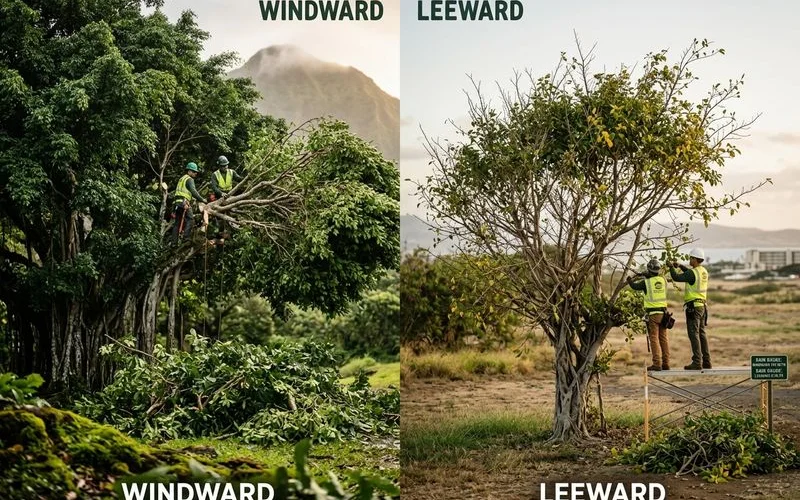
The windward side of Oahu, encompassing Kailua, Kaneohe, and Waimanalo, gets significantly more rainfall and consistent trade winds. Areas near the Koolau mountains easily see over 60 inches of rain annually. Both of these environmental factors push tree growth incredibly fast.
We find that trees in these lush areas typically need trimming four to six months sooner than the exact same species planted on the drier side of the island. The constant moisture also increases the physical weight of the canopy.
The leeward side presents a very different environment. Neighborhoods like Aiea and Pearl City average less than 20 inches of annual rainfall, so growth remains steady but lacks the explosive speed seen over the mountains.
Key Regional Growth Factors:
- Windward (Kailua/Kaneohe): 60+ inches of rain, high trade winds, fast growth requiring shorter trimming intervals.
- Leeward (Aiea/Pearl City): Under 20 inches of rain, lighter winds, steady growth allowing slightly longer intervals.
- Transition Zones (Hawaii Kai): Moderate rain with coastal salt exposure, requiring special attention for sensitive palms.
You can safely stretch maintenance intervals a few extra months on the leeward side without creating a hazard.
Pre-Storm Timing
Beyond regular maintenance, any property is dramatically improved by a targeted pre-storm canopy thinning in late spring or early summer. The Central Pacific hurricane season officially runs from June 1 through November 30. Your main goal is to reduce the physical wind load on the tree before the most active months of August through October arrive.
We always perform a strategic thin for this specific purpose, rather than a full structural prune. This preventative measure goes on top of the normal trimming schedule, not in place of it. Removing crossing branches and heavy end-weight allows high-velocity storm gusts to filter through the leaves safely. Properties that invest in this June preparation consistently suffer far less damage when tropical depressions hit.
How to Decide for Your Specific Trees
Generic schedules offer a great starting point for property planning. The exact right interval for your specific landscape depends heavily on the species, location, age, surrounding structures, and your long-term goals. An on-site visit from an ISA Certified Arborist identifies exactly what assets you have.
We use these assessments to set a safe, customized timeline that shifts as your greenery matures. For most homeowners, the smartest approach involves a professional inspection cycle every 12 to 18 months to catch early warning signs.
During a standard arborist inspection, you can expect:
- A full assessment of structural integrity and wind load
- Identification of hazardous deadwood hidden in the canopy
- Customized trimming recommendations based on current growth
You trim what actually needs trimming at each scheduled visit. Some years might require a full canopy thin, while other visits might just focus on removing hazardous deadwood. Your local arborist tracks these changes and tells you exactly what is required and when to do it.
Common Questions
How often should trees be trimmed in Hawaii?
Why do Hawaii trees need more frequent trimming?
Can I skip trimming for a few years to save money?
Related Guides
Best Time of Year to Prune Trees in Hawaii
Hawaii's tropical climate changes pruning timing. When to thin canopies for storm season, when to prune for flowers and fruit, and when to wait.
Crown Thinning vs Crown Raising
Crown thinning and crown raising solve different problems. When each is appropriate, what they do for the tree, and how to ask for the right service.
Deadwood Removal: Why It Matters
Dead branches don't just look bad — they're a safety hazard. What deadwood removal is, why it matters, and when to schedule it.
Tree Trimming Cost Honolulu
What drives tree trimming cost on Oahu — tree size, canopy density, access, and trimming frequency. Typical ranges and how to compare quotes.
Ready for Expert Tree Care on Oahu?
ISA-certified arborists, transparent pricing, and 24/7 emergency response. Get a free on-site quote today.