
Do You Need a Permit to Remove a Tree in Honolulu?
Honolulu tree-removal permits explained — Exceptional Trees, protected species, and what the City & County requires before any work begins.
· 6 min read
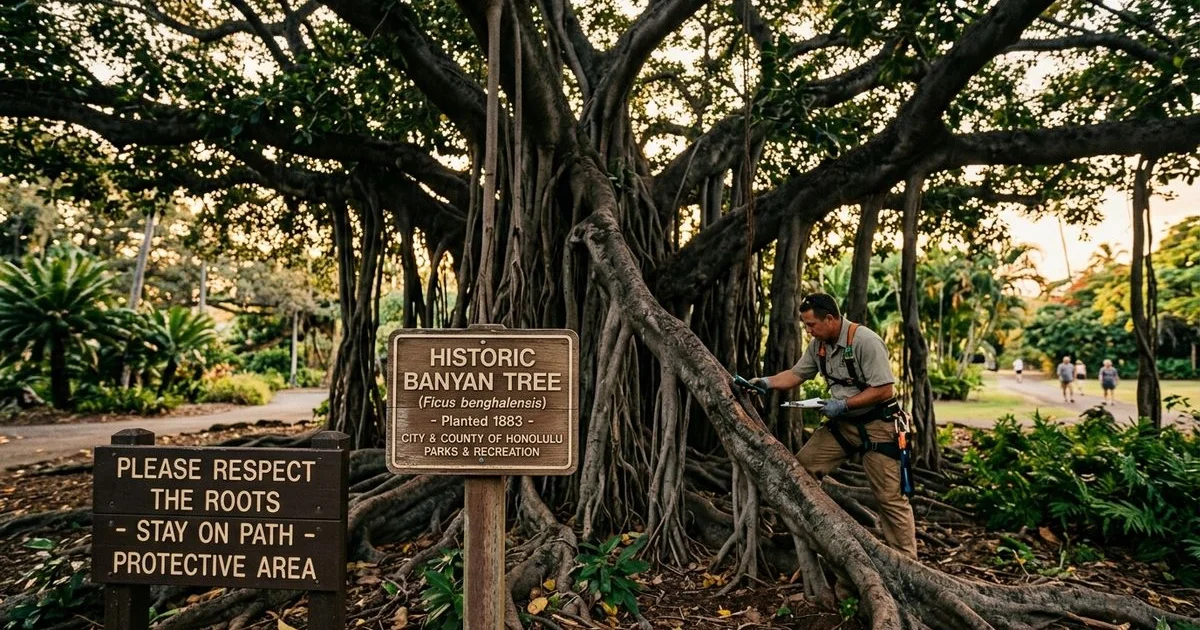
We see property projects stall out all the time over a single misunderstood landscaping rule. You know how confusing local zoning laws can get when a large banyan or mature monkeypod sits right in the middle of a planned expansion.
Our crews handle these exact scenarios daily across Oahu.
Securing a tree removal permit Honolulu application correctly is the only way to keep your project moving forward. Let’s look at the actual city regulations, what the data says about protected species, and how you can safely clear your lot without triggering massive fines.
The Short Answer
For most trees on private property in Honolulu, you do not need a permit. You can remove a standard yard tree, a stump, or a palm without filing any paperwork with the City and County of Honolulu. We always advise clients to verify their plant species first.
The exceptions to this rule are highly specific and carry severe financial consequences if ignored. Our experience shows that skipping the verification step is the most common mistake local property owners make.
Two main categories require formal city approval: Exceptional Trees and certain protected native species. Knowing the difference upfront prevents stop-work orders and keeps your property development on track.
Exceptional Trees
Hawaii’s Exceptional Tree Act protects specific plants based on their historic, cultural, or aesthetic value. The Division of Urban Forestry (DUF) manages this strict registry under Chapter 41, Article 13 of the Honolulu city ordinances. We constantly remind property managers that designated plants cannot be altered without a rigorous formal review.
The process is far more complex than a standard building permit because it directly requires approval from the Honolulu City Council. Our teams have seen unapproved removals result in catastrophic project delays.
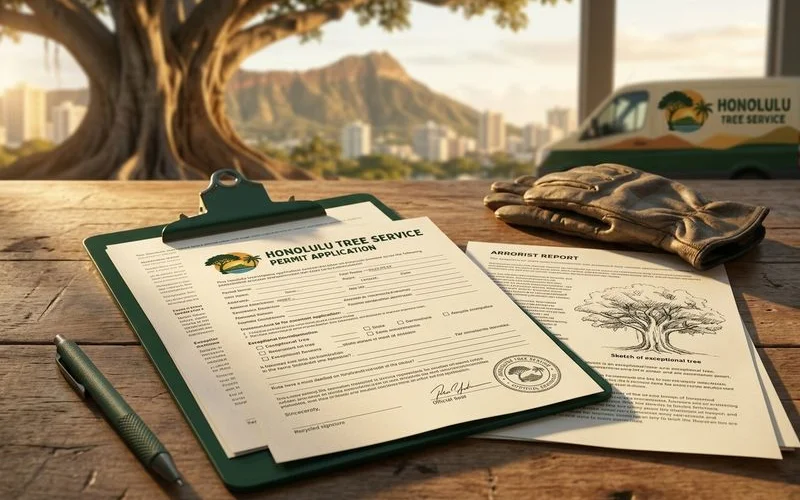
Exceptional Trees typically meet one or more of the following rigorous criteria:
- Significant age (such as century-old monkeypods, Indian banyans, or massive kapok trees)
- Unusual size or trunk diameter for their specific species
- Historic or cultural significance (often planted to commemorate a specific person or historical event)
- Extreme rarity within the Hawaiian islands
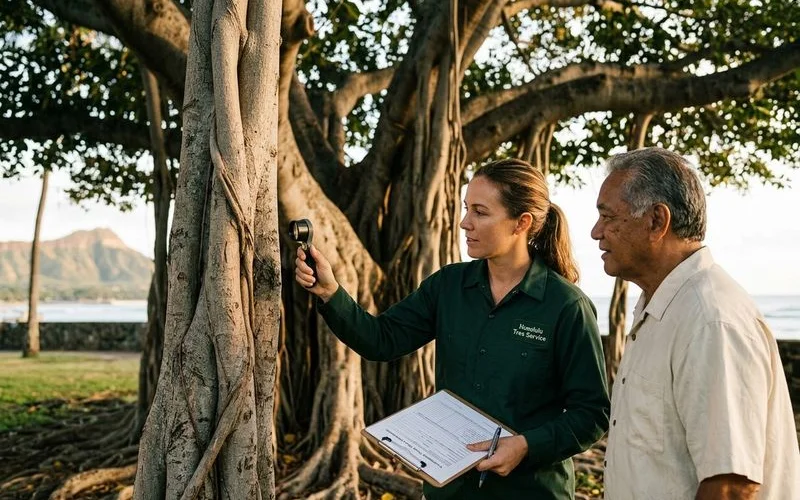
If your property contains a massive canopy that might qualify, an arborist consultation confirms the exact designation status before any cutting begins. You can also cross-reference your address with the City and County’s Exceptional Tree registry map. We highly recommend doing this during the initial property inspection phase.
Protected Species
Certain native Hawaiian species hold strict legal protections at both the state and county levels. Trees like koa, wiliwili, and the heavily monitored ʻōhiʻa lehua require special handling protocols. We always coordinate with the Department of Land and Natural Resources (DLNR) when dealing with these specific plants.
The ʻōhiʻa lehua faces a severe threat from Rapid ʻŌhiʻa Death (ROD), a fungal disease that dictates exact removal and disposal methods. Our crews follow these quarantine rules strictly to prevent spreading the pathogen across Oahu.
Cutting or damaging a protected native species on private property carries steep penalties. You must hire an ISA-certified professional to verify the species before you schedule a clearing crew.
What Triggers a Permit Need
You absolutely need a permit if your situation matches any of these specific conditions:
- The tree currently sits on the city’s official Exceptional Tree registry
- The plant is a protected or endangered native species like koa or ʻōhiʻa lehua
- The property sits in a designated historic district where all landscape modifications require architectural review
- The trunk grows in the public right-of-way, which requires a separate street-tree application
- The vegetation falls under a strict homeowner’s association covenant or specific deed restriction
You likely do not need city authorization if your project meets these simple criteria:
- The tree is a standard, non-Exceptional yard plant located entirely on your private property
- The species is an introduced, non-protected variety
- The trunk and root system sit completely clear of the public right-of-way
When in doubt about a specific property boundary, simply ask the city. We find that the cost of a quick professional confirmation is always lower than the massive fines for an unauthorized removal.
The Tree Removal Permit Honolulu Process
When an official application is required, the city enforces a very structured administrative path. We guide clients through this exact sequence to prevent application rejections. The Division of Urban Forestry will not approve incomplete files.
- Confirmation of status: Verify whether the plant qualifies as an Exceptional or protected species using city maps.
- Application filing: Submit a formal written request to the city detailing the proposed extraction, alongside required property documents.
- Arborist report: Hire an ISA-certified arborist to document the health condition, justify the extraction, and propose replacement planting.
- City review: Urban Forestry staff evaluate the file, which often includes a mandatory public notification period.
- Final decision: The city issues an approval, an approval with strict mitigation conditions, or a flat denial.
- Removal authorization: Heavy work can only begin after you receive the physical written approval document.
The review timeline fluctuates wildly depending on the species and location. Dead Exceptional Trees or immediate hazard cases move through the system relatively quickly. Our tree removal crews include dedicated permit support in every quote when this specialized path is required. Contested cases requiring a full City Council vote can delay a project for several months.
Penalties for Skipping the Process
Removing an Exceptional or protected tree without proper authorization triggers severe financial and legal consequences. We have seen unpermitted removals completely derail commercial and residential construction projects. The local ordinances establish a strict penalty framework.
- Base civil fines starting at $1,000 per violation
- Immediate stop-work orders that freeze all site construction
- Mandatory replanting requirements or expensive ecological mitigation fees
- Potential felony charges for poaching highly protected woods like wild koa
The financial impact of a violation often exceeds the property’s entire landscaping budget. Our safety team always tells clients that doing the job legally is the only cost-effective strategy.
Emergency Hazard Removals
If an Exceptional Tree splinters in a severe tropical storm or becomes an immediate threat, the standard timeline accelerates. The city provides specific provisions for emergency extractions when there is imminent danger to life or property. We prioritize these high-risk calls to secure the area immediately. Proper documentation is absolutely critical in these chaotic situations.
You must capture clear photographs of the damage, secure a fast arborist report, and notify the Division of Urban Forestry as soon as possible. Our 24/7 emergency dispatch handles the immediate hazard mitigation while recording the required proof for the follow-up paperwork.
Bottom Line
For most standard residential yards, you do not need a Honolulu tree permit to cut down a tree. The application process is non-negotiable for an Exceptional Tree Hawaii designation and any protected tree removal project.
We strongly recommend confirming your plant’s legal status before you schedule any heavy equipment.
Schedule an ISA-certified arborist inspection today, and quickly check your address against the city registry to secure total peace of mind. Protecting your property value means following the tree removal permit Honolulu rules and avoiding unnecessary municipal fines.
Common Questions
Do I need a permit to remove a tree on my own property?
What is an Exceptional Tree in Hawaii?
How long does the permit process take?
Related Guides
Emergency & Storm-Damaged Tree Removal
What to do when a tree falls or splits in a storm — safety steps, when to call for emergency response, and what 24/7 dispatch looks like on Oahu.
How Much Does Tree Removal Cost in Honolulu?
Tree removal cost breakdown for Honolulu — what drives pricing, typical ranges by size, when a crane changes the number, and how to get an accurate quote.
Large Tree Removal with a Crane
When crane-assisted tree removal is the right call — large trees, tight lots, near-line work, and what the process looks like on Oahu.
Tree Removal vs Tree Trimming: Which Do I Need?
How to decide between removing a tree and trimming it — when a tree can be saved with pruning, and when removal is the right call.
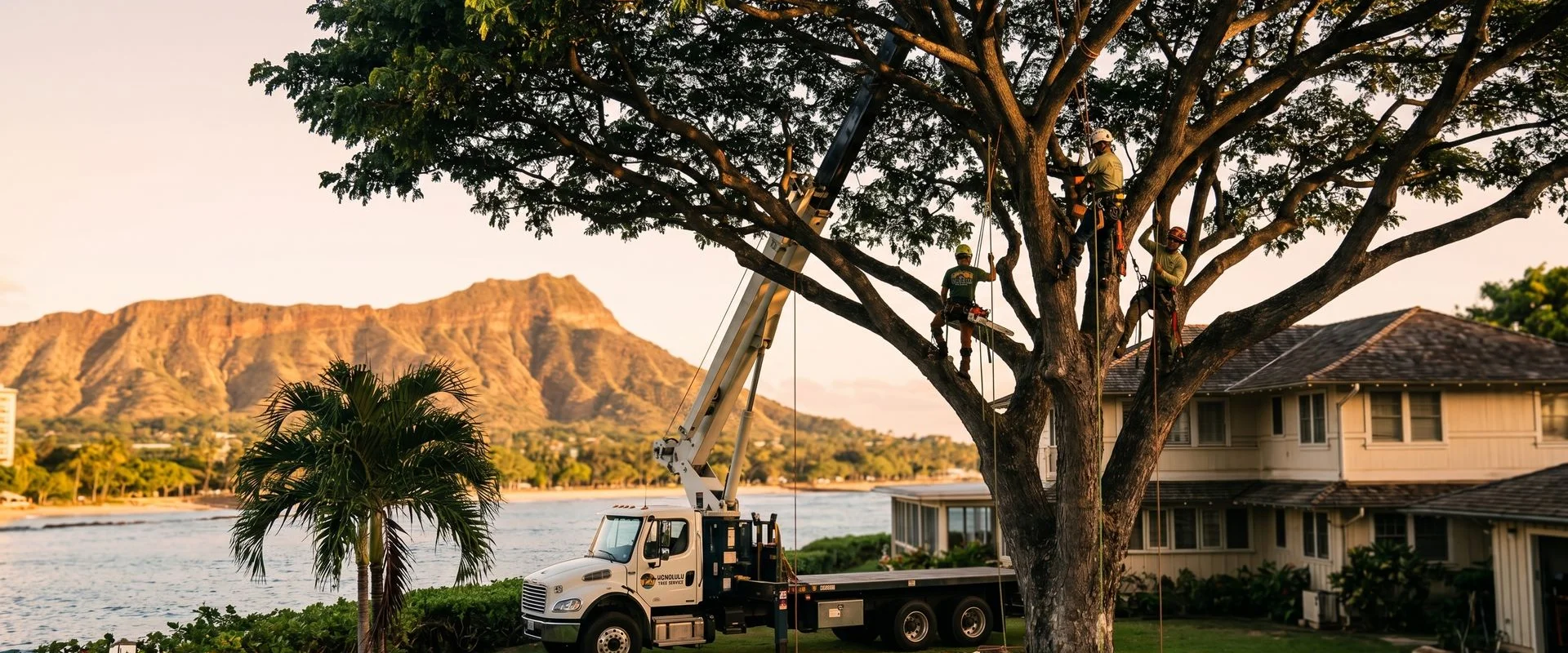
Ready for Expert Tree Care on Oahu?
ISA-certified arborists, transparent pricing, and 24/7 emergency response. Get a free on-site quote today.