
Emergency & Storm-Damaged Tree Removal on Oahu
What to do when a tree falls or splits in a storm — safety steps, when to call for emergency response, and what 24/7 dispatch looks like on Oahu.
· 6 min read
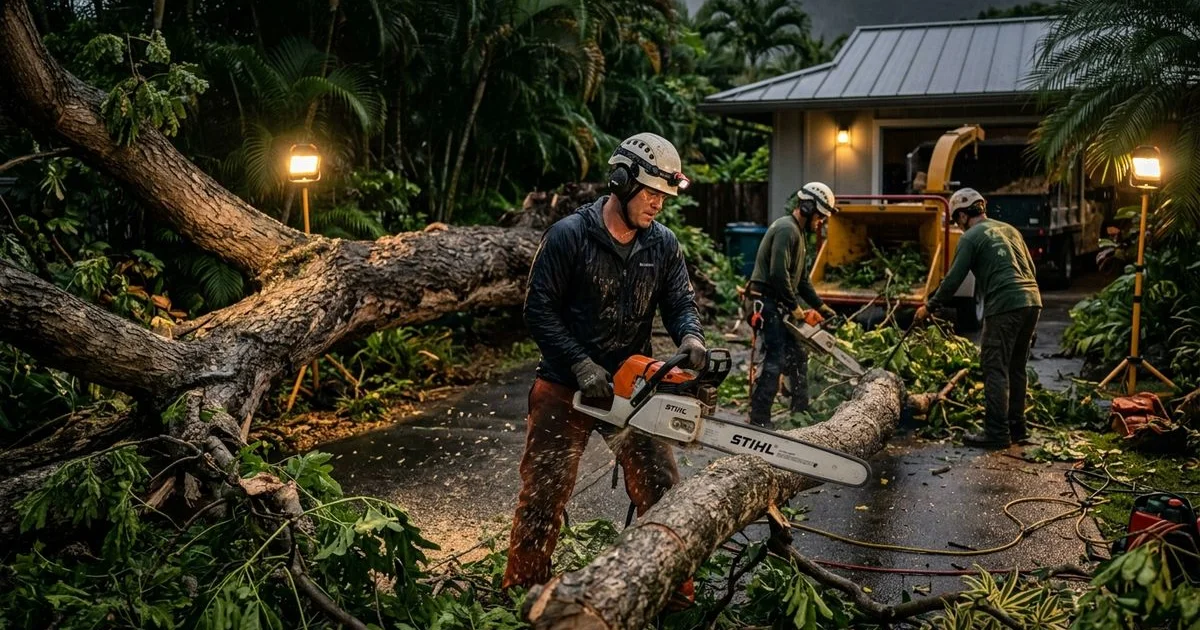
We see it after every major storm sweeps through Oahu. Property managers and homeowners are left staring at a massive mess of wood and wondering exactly what to do next.
The anxiety is completely understandable when a multi-ton branch is hovering over your living room.
Our team can break down the reality of emergency tree removal Honolulu properties require, what the data actually tells us, and how to safely secure your home.
What Counts as a Tree Emergency
An active tree emergency involves a direct threat to people, a risk of immediate property damage, or a blocked critical access path. A broken limb resting safely in the back corner of your yard can wait until morning. We use standard International Society of Arboriculture (ISA) guidelines to determine if an unstable plant requires immediate, after-hours intervention.
A leaning trunk resting on your roof, a massive branch suspended over a driveway, or any vegetation threatening a power line requires immediate action. Our teams prioritize these high-risk targets because the situation can degrade rapidly. Wind gusts can turn a stable, leaning trunk into a catastrophic roof collapse in minutes.
Here is exactly when you should request an emergency response:
- Structural contact: The trunk or heavy branches are actively resting on a house, garage, or vehicle.
- Imminent failure: The root plate is actively lifting from the surrounding soil.
- Trapped vehicles: A downed canopy is completely blocking your only exit route.
- Electrical hazards: Any part of the plant is touching or bringing down utility lines.
If none of these apply, you can safely schedule a standard next-day evaluation.
What to Do Right Now (Before the Crew Arrives)
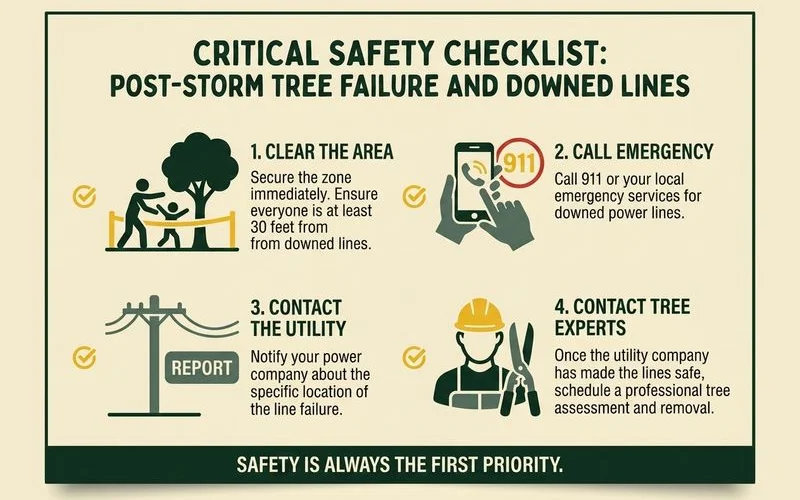
If a tree fails on your property, your immediate priority is isolating the hazard zone and calling for professional help. Do not attempt to move the wood or assess the damage up close. We always advise clients to assume the situation is highly volatile until professionals arrive.
Wind from a passing weather system can keep caught branches shifting for hours. Our recommendation is to keep all family members and pets entirely indoors and away from windows facing the debris.
Treat every downed utility line as fully energized. Hawaiian Electric Company (HECO) safety protocols require the public to maintain a strict distance of at least 30 feet from any fallen conductors. Call the HECO 24/7 trouble line at 1-855-304-1212 immediately if you spot a downed line.
Caught wood under tension, known in the industry as a “spring pole,” snaps unpredictably and causes severe injuries every year. We strongly warn against using personal chainsaws to clear debris that is leaning against structures.
Take clear photos of the damage from a safe distance for your insurance provider. Wide shots showing the context of the fallen tree response and close-ups of the specific structural impact will significantly speed up your claim.
What 24/7 Response Looks Like
A true emergency response focuses strictly on rapid hazard mitigation rather than a full cleanup. The immediate goal is to stabilize the situation and make the site safe. Our dispatch unit coordinates a 24/7 tree service Honolulu residents can rely on to secure dangerous situations fast.
The timeline of a typical after-hours call follows a strict, safety-first protocol. We triage incoming calls based on the severity of the structural threat and dispatch the nearest available crew.
Here is the standard progression for an urgent deployment:
| Response Phase | Target Timeline | Primary Objective |
|---|---|---|
| Intake & Dispatch | First 15 minutes | Gather location details, assess risk, and deploy the closest available crew. |
| Site Stabilization | First 60-90 minutes | Secure the perimeter, rig unstable branches, and safely lift the load off structures. |
| Complete Resolution | Within 24-72 hours | Perform full wood removal, stump grinding if needed, and site cleanup. |
For incidents involving major structural damage, coordination with other trades is essential. We regularly work alongside insurance adjusters, emergency roofers, and fencing contractors to ensure the property is fully secured.
Why Hazard Mitigation Comes First
Emergency crews prioritize mitigation because a storm-damaged tree on a roof holds massive amounts of stored kinetic energy. Cutting into this tension without proper rigging can cause the wood to violently snap or crash through the structure. Our arborists are specifically trained to read these invisible tension points before ever starting a saw.
The branches are bent under extreme load, and the internal wood fibers may already be fractured. The Occupational Safety and Health Administration (OSHA) warns heavily against the dangers of trapped tension in wind-thrown timber. A full removal in the middle of the night with limited visibility is a highly dangerous gamble.
Our phased dismantling approach involves three strict safety steps:
- Weight analysis: Assessing how much load is resting directly on the roof structure.
- Load transfer: Using specialized rigging to hold the canopy weight before making any cuts.
- Controlled relief: Slowly releasing the built-up kinetic energy piece by piece.
Sometimes hazard mitigation and complete cleanup happen simultaneously during daylight hours. The exact approach always depends on the specific site conditions and the immediate threat level.
Insurance Considerations
Most standard HO-3 homeowner policies will cover the cost of removing a tree if it directly damages a covered structure, minus your deductible. If a tree simply falls across your lawn without hitting anything, insurance typically will not cover the removal. We see this distinction confuse property owners after nearly every major storm.
Standard policies usually include a specific debris removal allowance, often capped between $500 and $1,000 per storm event. Your adjuster will need clear documentation of the hazard before mitigation began. The faster you photograph the initial impact and report the incident, the smoother the financial recovery process will be.
Keep these points in mind when dealing with claims:
- Document the scene immediately from multiple angles.
- Verify your specific hurricane or windstorm deductible.
- Save all invoices and assessment reports provided by the arborists.
We provide highly detailed, written invoices that perfectly align with local insurance adjuster requirements. The actual claim processing remains between you and your provider, but clear paperwork prevents unnecessary delays.
Pre-Season Preparation
The most effective way to handle storm damage is to eliminate the structural risks before high winds ever arrive. Proactive canopy thinning and deadwood removal drastically reduce the chance of catastrophic failure. We strongly encourage scheduling a property assessment before the Central Pacific hurricane season begins on June 1st.
Mature, top-heavy canopies catch the wind like a sail. A professional arborist can selectively thin the crown, allowing high winds to pass safely through the branches. Review our tree removal and consultation services to secure your yard ahead of the heavy weather.
Our experts look for highly specific red flags during a pre-storm evaluation:
- Root plate lifting: Newly formed soil cracks opposite the direction of a leaning trunk.
- Structural cavities: Large, hollowed-out sections in the main support trunk.
- Fungal brackets: Aggressive mushroom growth near the base indicating internal rot.
Do not wait for a severe storm to test a compromised root system. Get a written risk assessment and remove the hazard on your own terms.
Bottom Line
When dealing with a storm damaged tree Oahu residents need a fast, reliable response from a locally established crew. Time is the most critical factor when property and safety are actively threatened. We recommend calling a dedicated, year-round local service rather than relying on out-of-state storm chasers who temporarily flood the island after major events.
A rapid, localized response prevents further structural damage and keeps your family safe. Our 24/7 dispatch actively covers Honolulu, Hawaii Kai, Kailua, Kaneohe, Aiea, Pearl City, Mililani, and Waipahu. Emergency crews can usually secure true, high-priority hazards within an hour. Call our dispatch center the moment a massive failure puts your home at risk.
Common Questions
What should I do if a tree falls on my house?
Do you offer 24/7 emergency tree removal?
What does emergency tree response cost?
Related Guides
Do You Need a Permit to Remove a Tree in Honolulu?
Honolulu tree-removal permits explained — Exceptional Trees, protected species, and what the City & County requires before any work begins.
How Much Does Tree Removal Cost in Honolulu?
Tree removal cost breakdown for Honolulu — what drives pricing, typical ranges by size, when a crane changes the number, and how to get an accurate quote.
Large Tree Removal with a Crane
When crane-assisted tree removal is the right call — large trees, tight lots, near-line work, and what the process looks like on Oahu.
Tree Removal vs Tree Trimming: Which Do I Need?
How to decide between removing a tree and trimming it — when a tree can be saved with pruning, and when removal is the right call.
Ready for Expert Tree Care on Oahu?
ISA-certified arborists, transparent pricing, and 24/7 emergency response. Get a free on-site quote today.