
Signs Your Tree Is Dangerous or Dying
Self-diagnose hazardous trees on Oahu — leaning trunks, dead limbs, fungal growth, root damage, and bark issues. Know when to call an arborist.
· 6 min read
What to Look For
We constantly see property managers and homeowners caught off guard by fallen trees, even though the signs a tree is dangerous or dying were visible for years. The reality is that trees rarely fail without providing structural clues first.
On Oahu, year-round growth easily masks slow decline, while strong trade winds expose hidden weaknesses.
Our goal is to help you spot these issues early so you can protect your property and avoid a catastrophic failure. By recognizing the early indicators, you can address problems long before they require an emergency response.
Let’s look at the specific red flags that mean it is time to schedule an arborist consultation before the next storm season arrives.
Structural Red Flags
Sudden Lean
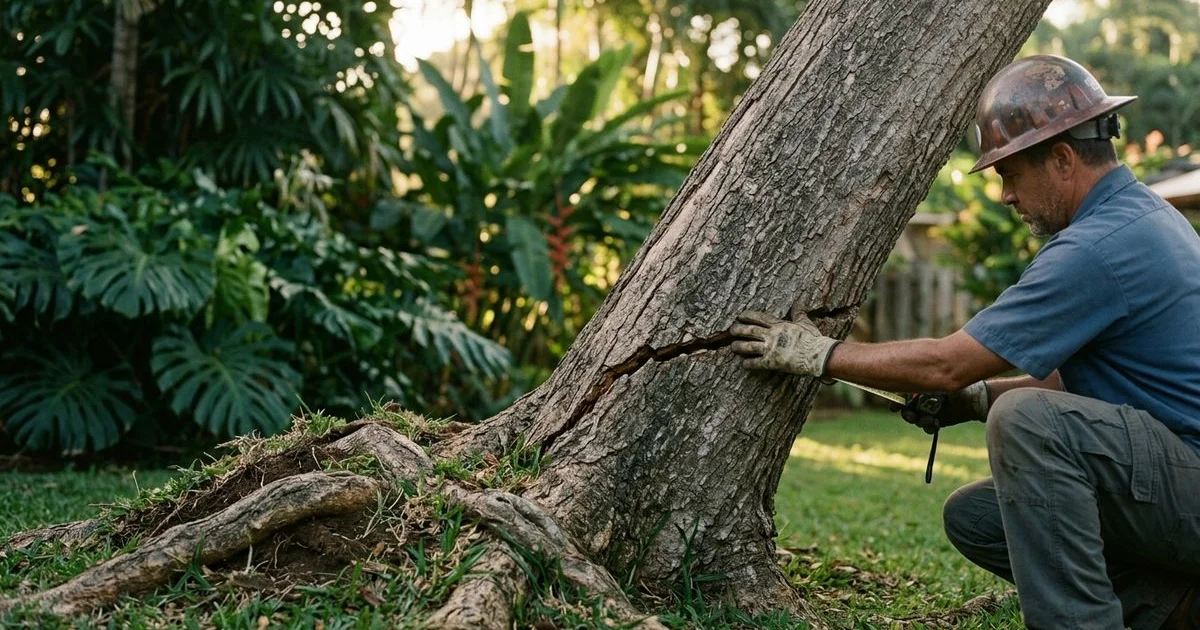
Our team always measures the angle of a leaning tree during a risk assessment. A tree that has gradually leaned over years of trade-wind exposure is usually stable because it grew reaction wood to compensate.
A sudden shift is an entirely different story. We consider any tree leaning past 15 degrees from vertical to be a significant leaning tree danger with a high risk for catastrophic failure, especially if the lean is actively worsening.
Look closely at the ground around the trunk for lifted turf or freshly exposed roots. Our immediate advice is to stop using the area underneath the tree if you notice soil cracking or heaving on the side opposite the lean, as this indicates active root failure.
Trunk Cracks and Splits
We classify trunk cracks by their depth and direction, since some are much more dangerous than others. Vertical cracks, splits at branch unions, or large cavities in the trunk all signal an impending structural failure.
Small fissures can rapidly grow into major splits during a high-wind event, making early detection critical.
Our arborists pay special attention to shear cracks that extend deep into the actual wood rather than just the surface bark. These deep structural wounds severely compromise the ability of the trunk to hold its own weight.
You should treat any crack separating the main stem as an urgent hazard.
Co-Dominant Stems
We frequently remove trees that have split right down the middle due to co-dominant stems. Trees that fork into two equal-sized main trunks from a single point are inherently weaker than single-stem trees.
The core problem lies in the tight V-shaped union where the two stems meet. Our inspections often reveal included bark trapped inside these tight crotches, which prevents the two stems from fusing securely.
These weak unions are notorious for splitting under heavy wind loads. You will see this failure pattern often on mature monkeypods, banyans, and shower trees across Oahu.
Health Red Flags
Fungal Growth at the Base
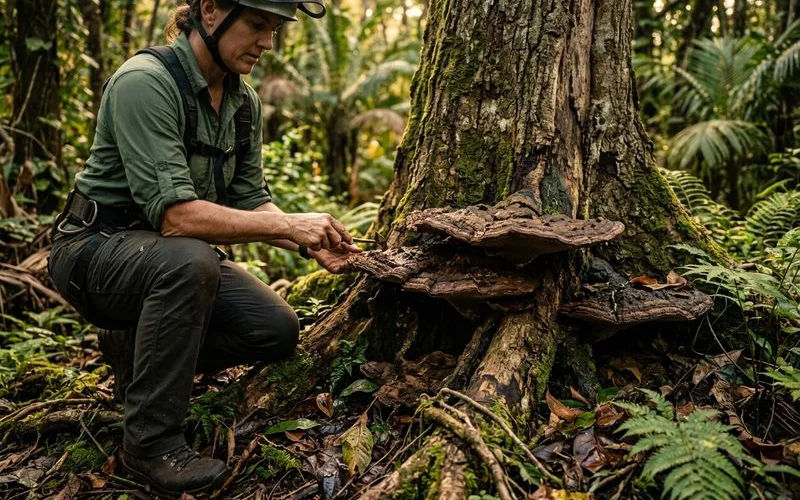
We consider fungal growth at the base of a tree to be one of the most reliable indicators of severe internal decay. Mushroom-like growths, called conks or brackets, are the visible fruiting bodies of a massive infection hollowing out the wood inside.
A specific threat on Oahu is Ganoderma zonatum, a lethal fungus that causes butt rot in palms and large hardwood trees. Our crews cannot save a tree once this type of aggressive wood-decaying fungus establishes itself in the lower trunk.
The structural integrity of the base is likely already compromised by the time you see these conks. You must schedule an immediate professional risk assessment if you spot brackets growing on a mature monkeypod or banyan.
Thinning or Asymmetric Canopy
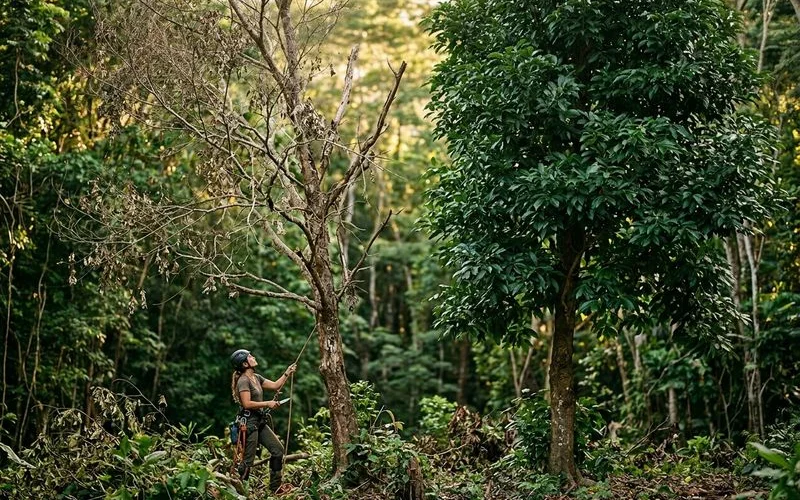
We advise property owners to compare the current canopy density of their tree to how it looked the previous year. A sparse canopy, dead limbs in the upper crown, or noticeable asymmetry are all clear dying tree signs that suggest a severe decline in health.
A mature tree that loses more than 30 percent of its foliage in a single season is actively struggling to survive.
The leaves rely entirely on the root system for water and nutrients. Our experience shows that sudden canopy thinning is almost always a symptom of extensive underground root damage.
Keep an eye out for these changes during the peak growing season when the leaves should be full and vibrant.
Peeling Bark and Cankers
We closely examine areas where long vertical strips of bark are peeling away from the trunk. While some bark exfoliation is perfectly normal for species like eucalyptus or plane trees, abrupt peeling on other species is a clear warning sign.
Sunken, discolored patches known as cankers often indicate a severe bacterial or fungal infection beneath the surface. Our arborists often find wood-boring insects taking advantage of the stressed tissue in these exposed areas.
The tree loses its protective barrier when the outer bark falls off unexpectedly. This exposure leaves the inner wood vulnerable to further decay and structural weakening.
Environment Red Flags
Recent Construction Near the Tree
We see countless mature trees die slowly over three to five years simply because of nearby construction. Severed roots from trenching, compacted soil from heavy equipment, or changed drainage from new hardscapes can devastate a root system.
The International Society of Arboriculture defines the Critical Root Zone as needing at least one foot of protection radius for every inch of trunk diameter. Our teams know that digging inside this critical zone cuts off the primary source of stability and nutrients.
A tree deserves a thorough inspection if you have built or renovated near it within the last few years. The resulting decline is slow and largely invisible at first, but the damage is often permanent by the time you notice smaller leaves or dieback.
| Trunk Diameter (DBH) | Minimum Protection Radius | Risk of Root Cut |
|---|---|---|
| 10 inches | 10 to 15 feet | High structural risk if cut closer |
| 20 inches | 20 to 30 feet | Severe canopy decline expected |
| 30 inches | 30 to 45 feet | Catastrophic failure possible |
Storm Damage You Can’t See
We always remind clients that wind events on Oahu can crack heavy branches deep inside the canopy without snapping them off completely. Normal trade winds are manageable, but storm gusts exceeding 40 miles per hour can twist and fracture large limbs.
A storm-damaged tree might look perfectly fine from the ground while hiding massive hazards 30 feet up in the air. Our post-storm inspections focus heavily on identifying hangers, which are detached branches suspended precariously in the crown.
Walk your property after a major storm and look up into the canopy for fresh cracks or torn bark. Falling branches pose a severe risk to anyone walking below, so prompt removal is critical.
When to Act
We group hazard signs into three categories to help you decide how quickly to act. Some signs mean you should simply monitor the tree and re-inspect it next season. Other symptoms mean you need to call a certified arborist this week for an evaluation.
Our most urgent category means you must stop using the area immediately and call for emergency service today. Urgent and immediate hazards include the following visible signs:
- Fungal conks at the base of a large tree
- A sudden lean exceeding 15 degrees with visible root heave
- Major trunk cracks or V-shaped unions actively opening up
- Hanging limbs suspended in the canopy after a storm
We recommend a professional diagnosis for everything else, such as a sparse canopy, peeling bark, or a slow lean. An ISA-certified professional can evaluate a hazardous tree Oahu property owners are concerned about to tell you whether it can be saved, treated, or needs to come down.
Please do not guess about property safety. Our clients find that the cost of a consultation is a tiny fraction of a tree removal service.
More importantly, it is significantly cheaper than the $10,000 to $15,000 average insurance claim for a tree falling on a house.
Common Questions
How do I know if a tree is dying?
Is a leaning tree always dangerous?
What's the most reliable sign a tree needs to come down?
Related Guides
Caring for Native Hawaiian & Tropical Trees
Care guide for Oahu's most common trees — monkeypod, plumeria, coconut palm, banyan, mango, and more. Species-specific pruning, health, and risk.
How to Choose a Tree Service Company in Honolulu
A practical checklist for hiring a tree service on Oahu — ISA certification, insurance, written estimates, ANSI standards, and red flags to avoid.
Tree Care Cost Guide Honolulu
A whole-specialty cost overview for tree care on Oahu — what drives pricing for removal, trimming, stump grinding, and palm work.
Ready for Expert Tree Care on Oahu?
ISA-certified arborists, transparent pricing, and 24/7 emergency response. Get a free on-site quote today.