
Tree Risk Assessment: What to Expect on Oahu
What happens during a professional tree risk assessment — inspection, documentation, risk rating, and recommendations. When to schedule one.
· 5 min read
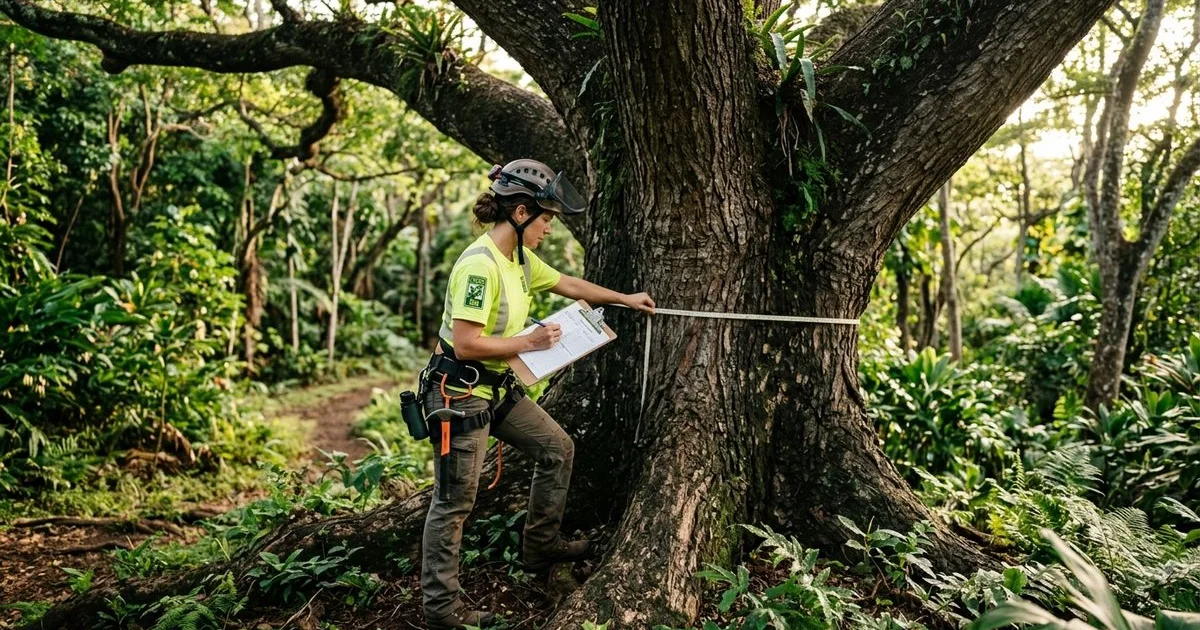
Managing mature trees involves a careful balance between preserving natural beauty and protecting your property from liability. Our team sees many property owners confusing a quick visual check with a formal evaluation.
A casual opinion will not hold up in court or satisfy an insurance carrier after a storm. The reality is that true protection requires a documented, standardized tree risk assessment.
That is where a structured approach changes everything.
Our arborist consultation service steps in to provide the exact level of formal documentation your specific situation requires. Let’s break down the methodology behind these assessments, what the on-site inspection looks like, and how you can use the final report.
What a Risk Assessment Is
A tree risk assessment is a formal, documented inspection that quantifies the danger a specific tree poses to people or property. This process strictly follows the ANSI A300 Part 9 standards for tree risk management.
Our certified arborists use the ISA Tree Risk Assessment Qualification (TRAQ) methodology to ensure every report is defensible. This standardization completely removes the guesswork from tree care. A proper TRAQ assessment Hawaii property owners rely on evaluates safety using a precise mathematical matrix.
It calculates the final risk rating by multiplying the likelihood of failure, the probability of impacting a target, and the severity of the consequences. You will typically encounter three levels of assessment depending on your exact needs.
| Assessment Level | Methodology | Best Used For |
|---|---|---|
| Level 1 | Limited visual inspection from one side or a drive-by. | Large populations of trees, initial triage. |
| Level 2 | Basic 360-degree visual inspection of the roots, trunk, and canopy. | Standard residential and commercial requirements. |
| Level 3 | Advanced diagnostics using specific tools like a resistograph or sounding mallet. | High-value trees with suspected internal decay. |
When to Schedule One
If you simply need to know how to properly prune a backyard monkeypod, informal advice is usually fine. A formal risk assessment is appropriate whenever financial, legal, or safety stakes require official documentation. You need this level of detail when dealing with insurance claims, municipal permits, or severe structural decline.
Our clients typically schedule these inspections for several critical reasons. The most common triggers include strict HOA requirements or requests from insurance carriers after a major weather event.
- Insurance or HOA mandates. Many carriers require documented tree inspections before renewing policies or after a claim.
- Exceptional Tree removal. Hawaii passed the Exceptional Tree Act (Act 105) in 1975 to protect designated trees. Removing or heavily modifying these trees requires a formal permit backed by a professional report.
- Pre-storm planning. Documenting conditions before hurricane season helps identify trees needing immediate action.
- Construction planning. Mature trees near development sites need pre-construction baseline documentation to protect root zones.
- Signs of structural decline. Fungal conks, deep structural cracks, or a severe lean warrant immediate documented inspection.
We often see significant issues hidden beneath a healthy-looking canopy. For example, Cook pines in Hawaii are highly susceptible to Formosan subterranean ground termite infestations. These aggressive pests can completely compromise a tree’s internal structure within just 18 months, leading to a basal failure.
A formal assessment catches these hidden dangers before they turn into emergencies.
What the Arborist Inspects
A complete tree risk assessment evaluates four main categories to build a clear picture of stability and health. The inspector looks closely at the tree structure, the biological health, the surrounding targets, and the environmental factors.
Tree Structure
Evaluating the physical integrity of the trunk and branches is the first critical step. Our inspection process identifies several common structural defects:
- Co-dominant stems with included bark.
- Deep vertical cracks in the trunk.
- Basal cavities hidden near the root flare.
- Signs of soil heaving along the visible roots.
For Level 3 advanced assessments, the inspector will use specialized equipment. A sounding mallet helps identify hollow areas inside the trunk by listening for auditory changes. A 4-foot metal probe is often used to measure the exact depth of visible cavities or weak wood.
Tree Health
Biological health directly impacts a tree’s ability to withstand stress and heal from wounds. The arborist checks the canopy density, leaf color, and foliage size against historical norms for that specific species.
We look for specific disease markers and pest signs during this phase. Identifying the exact pattern of deadwood can reveal issues like a spreading fungal infection or a vascular disease restricting nutrient flow.
Surroundings (Targets)
A tree only poses a risk if there is something valuable for it to hit. This phase catalogs the specific targets located within the potential fall zone. The report will detail:
- Frequency of human occupancy beneath the canopy.
- Proximity to primary residential or commercial structures.
- Vulnerable parked vehicles or high-traffic roadways.
- Overhead utility lines and ground-level infrastructure.
Our assessors calculate the exact probability of an impact occurring. This data directly influences the final mathematical risk rating.
Environmental Factors
The site conditions play a massive role in tree stability. The arborist will evaluate the site’s exposure to prevailing winds and check for recent soil disturbances.
Construction activities, regrading, or changes in drainage can severely damage root zones. We also analyze neighboring trees, as their presence or recent removal can significantly increase or buffer wind loads.
What the Report Includes
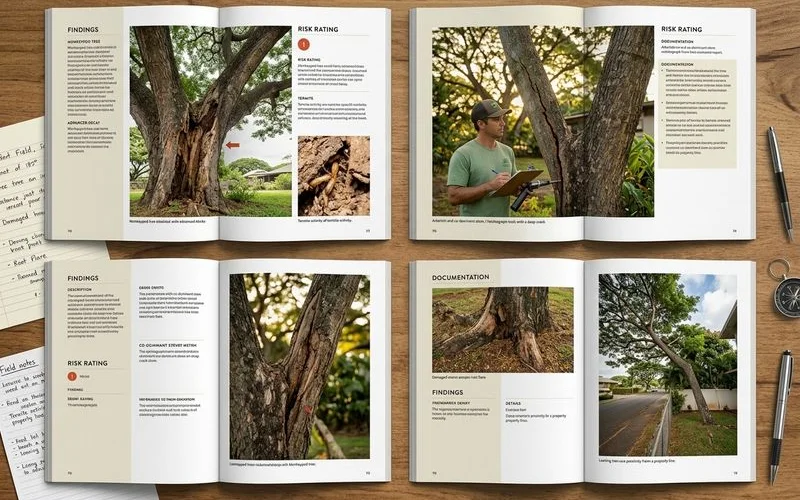
A typical risk assessment report provides a clear, standardized summary of the inspection findings. It covers everything from basic property identification to the final risk mitigation plan.
Our reports follow the standardized ISA framework to ensure universal readability for insurance adjusters and city planners. You receive a professional document detailing the inspection methodology, whether that involved a basic visual check or specialized diagnostic tools like a resistograph.
The core of the document focuses on the specific observations and the calculated risk rating. Your final action plan will typically include:
- Specific timeframes for monitoring the tree.
- Precise pruning or treatment instructions.
- Clear removal recommendations if the hazard cannot be mitigated.
How Long It Takes
The timeline for a tree risk assessment depends entirely on the property size and the required assessment level.
- Single residential tree: One to two hours on-site for a basic Level 2 inspection.
- Multiple trees: Two to four hours of field work.
- Commercial estates: A full-day or multi-day inspection for dozens of mature specimens.
Our team then requires additional time in the office to process the data and write the final report. The final written reports are typically delivered within one week of the site visit.
Expedited processing is often available for emergency situations or tight pre-construction deadlines.
What to Do With the Report
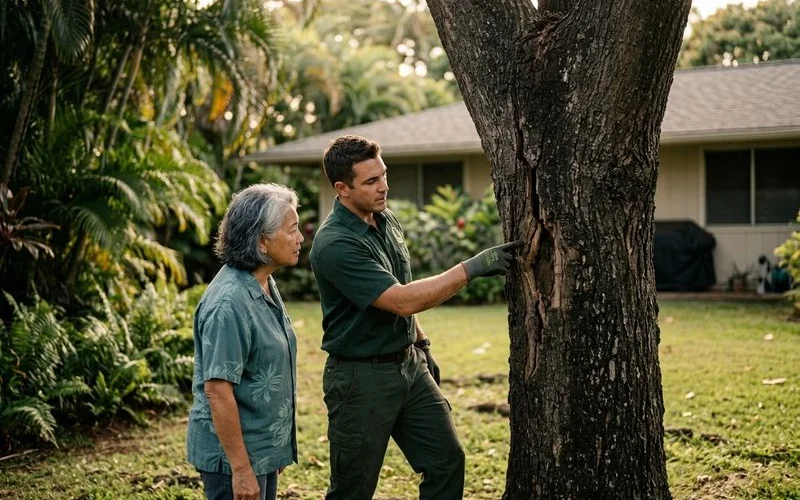
The finalized arborist tree report becomes your official record of the tree’s condition on a specific date. You can immediately use this document to satisfy insurance requirements, provide proof to an HOA, or support permit applications.
Our clients frequently use these reports as a baseline for long-term property management. Comparing new assessments against historical data makes it much easier to track structural changes over time and prioritize your tree work budget.
Many property managers schedule annual or biennial assessments to stay ahead of potential liabilities. The cost of maintaining regular documentation is significantly lower than the financial and legal fallout from one major tree failure incident.
Bottom Line
A tree risk assessment delivers a structured, documented professional opinion when the financial or safety stakes are high. Schedule a formal inspection when insurance mandates, construction plans, or concerns about a specific tree require more than just casual advice.
Our goal is to give you the data you need to make confident decisions. This document becomes your permanent record and your strongest protection against liability.
Reach out to schedule an assessment today to ensure your property remains safe, compliant, and protected.
Common Questions
What happens during a tree risk assessment?
When should I get a risk assessment?
Is risk assessment different from a regular consultation?
Related Guides
Tree Preservation Planning for Construction Projects
Construction near mature trees needs a preservation plan. Root-zone protection, tree protection zones, and post-construction care explained.
What Does an ISA Certified Arborist Do?
ISA Certified Arborists are trained tree-care professionals. What the credential means, what they do, and why it matters when hiring tree work.
Need expert help on this?
Learn more about Arborist Consultation & Plant Health
See our Arborist Consults service
Ready for Expert Tree Care on Oahu?
ISA-certified arborists, transparent pricing, and 24/7 emergency response. Get a free on-site quote today.